Monday, 6 October 2014

Objectivity in documentary photography

The first set exercise in this course is to look at news photographs of emergencies and consider whether it is possible to create truly objective images of these occurrences.   

I very rarely watch the news; I hear snippets of some of the disgusting things that are happening in the world today but I really don’t want it ramming in my face while eating breakfast. As a result, I really wasn’t prepared for the sick feeling in my stomach when researching the suggested ‘Abu Graib’. As I viewed the repulsive images on the page one word rattled around my head: why?

I don’t know what reaction the photographers were aiming for but one thing is certain, they most definitely were aiming for a reaction. My emotional response, and I’m sure I’m among many, suggests that these images evoke personal feelings. Surely these personal feelings must be amplified for the photographer and with these feelings in force, is it really possible to record such moments with an objective eye.

The nature of a photograph gives an impression of objectivity; as with film, it is recording reality. If we thought no further we could probably deduce that yes, documentary photography is always objective. Delving deeper though, we need to look at what is not within the frame to fully answer this question. Why did the photographer choose this viewpoint, this focal length and this exact moment to hit the shutter? What is outside the frame, behind the photographer, what happened just before or the moment after?

‘Objective’ means free of bias or prejudice caused by personal feelings. What makes a documentary photographer decide to capture an image; something which captures them, takes their interest has a chance of capturing the hearts and minds of the reader making a successful photograph. Randomly snapping without feeling probably wouldn’t make for interesting news so I suppose the question is, should there be objectivity in documentary photography?

Don McCullin, famed war photographer believes that his success is in his emotional approach. McCullin’s ethos is to be there, feel it, live it and look at what’s in front of you in order to capture so much more than visual impact. This could not and I believe should not be done with objectivity.

This aside, most would say that the one thing they should expect from the news is the truth. With so much subjectively captured imagery, are we getting the truth? We can all see by scanning the headlines that each newspaper has their own personal perspective on the truth; naturally, the accompanying photography mirrors those versions.

My research lead me to browse Google Images using various famed emergencies, the wars in Syria and Afghanistan and the London Bombings among others. What interested me the most when searching the Syrian war was the quick search buttons above the images. Assumingly influenced by popular searches, these buttons were entitled: children, destruction, crimes and bodies. These four words tell me without even clicking on the links that I am going to feel something when I browse the images. Am I going to feel proud, looking at photographs of soldiers adorning medals, or even a little uneasy viewing them fighting, brandishing guns?  No, the four main groups of image under this title are going to show me death and destruction; not just the soldiers who have signed up to fight but innocent children whose only crime is being born in a time and place where bad things happen.

Objectivity? I think not...

Why do we take the same photos?

Guided by the course notes, I have been looking at some of the photographs collected by and an interview with Joachim Schmid.

Starting in flea markets, Schmid collected hundreds of other people’s photographs and began to curate them into themes. During this process, he realised that there is much repetition in what people photograph. Schmid has now moved to mainly browsing the internet via Flickr and such sites to enhance his collection but the sentiment remains; we all seem to take the same photographs.

Many of this repetition is brought about by occasion: bride and groom, men holding prize fish, gatherings of students, soldiers, old friends. The list is endless, so large that Schmid has divided his images into ninety six books, each titled by group. Steeped in today’s culture is the selfie; mainly taken on mobile phones, such images not only show where the owner has been but their inclusion proves that they were there, usually having an amazing time.  

Schmid notes that we often photograph the good things in life, the brighter side of raising children, happy times with friends and partners. The fact is people prefer to publish a rose tinted version their world. A quick browse on Facebook shows images and statuses which could make us think everyone has a life far more exciting than our own. There’s the odd sympathy seeking ‘I’m so sad’ status but on the whole we aim to show our best side.

One place I have noticed people revelling in the murkier side of life is the traveller photos on sites such as Tripadviser. Reviews of any kind rarely give an average rating and as with the written, these photographs show either the best or the very worst of what their holiday accommodation had to offer. The few of these I have witnessed already show much repetition: mouldy shower trays, bare electric wires and cracked plug sockets seem to be the mainstay of the negative photographic review.

Photography at its most distressing is the reserve of the professional world; granted professionals are most often employed to shoot happy occasions, however at the other end of the scale, war photographers shoot scenes of terrible pain and devastation. This genre of photography as a hobbyist or passerby would be considered incredibly bad form. I will be delving further into this genre in my next exercise.


This interview has made me think about my own photography, both personal and professional. As a result of my learning, I have noticed a change, not only in the quality of my holiday photos but in what I choose to shoot. Have I become more original or have I just entered a new group taking typical images for an educated photographer on holiday? I suppose that’s worth a bit of research.

I remember that whilst editing my first wedding, I was devastated to realise that I hadn’t taken a close up of the rings. The bride and groom didn’t even notice but at the time, I considered it to be quite negligent. So why do we have the same old photographs taken at a wedding, the rings, the kiss, the never ending array of group shots? Surely a reportage style would be better suited to capture the essence of the day. It is true that things are changing, probably due to high competition in the market, originality is key and new styles are creeping through – ironically, in my quest for originality, I often browse other people’s work – go figure!


Sunday, 5 October 2014

Decoding advertisements

In a bid to avoid looking at gruesome images of emergencies, I decided to take a look at Judith Williamson’s work on decoding advertisements. Encouraged to consider why the image below might work in an ad for a health product, I began to consider each individual element. Williamson discusses the handshake as being the ‘punctum’ of the image. Barthes describes the punctum as the rare detail which draws us to an image; which moves us on from liking the image to loving it. 


Although there is no doubt that the handshake is the punctum and the lab coat, stethoscope and clipboard the signifiers, I was compelled to consider the other elements of this image. Having been created for purpose, I would suspect that nothing entered the shot without careful consideration.
I began with the room; almost white walls signify all important cleanliness, the hint of colour giving a warm, friendly feel. The colour continues to the shelving and files, showing order and organisation, this is followed up with the addition of a clock – well, we’ve all been kept waiting longer than we’d like for medical appointments. Ten past ten, hands balanced aesthetically and it’s mid-morning, a time when most are feeling fresh. The certificate on the wall balances the clock while symbolising professionalism.

I found the doctor interesting; the short hair and glasses give a professional appearance but I feel a human element has been added. The choice of pale blue shirt (matching the clipboard) with a shiny striped grey tie show an individual style, backed up by the goatee beard. These latter elements go as far as to make the medic clearly more notable than the client who is dressed in an insignificant grey shirt. In fact the only parts of the client that stand out to me are the parts which show connection, namely the handshake and the clear eye contact leading back to the smiling, welcoming face of the doctor.


I have limited experience in the world of ‘set up’ photography so taking the time to consider the work that goes into this genre has been interesting for me. I find it quite remarkable just how much thought goes into the generation of a single image. 


Saturday, 16 August 2014

Don McCullin, Jason Bell, Yousuf Karsh

Don McCullin
Don McCullin grew up on a London council estate and at age five, was evacuated to Somerset. Seperated from his sister, who was placed with a much wealthier family, McCullin developed issues about class and poverty; his affinity to persecuted peoples developed later through being beaten at a later placement. McCullin left Art College to support his family aged fourteen, following the death of his father. Severely dyslexic and having not done well in school, McCullin was a self confessed tear-away until a gang acquaintance was involved in the murder of a police man. McCullin, having photographs of the gang was immediately in demand with the press; this was the beginning of a lifelong career in photography.


McCullin’s photography is described as exceptionally powerful and technically sound. He uses relatively simple equipment, never a flash and rarely has a need for cropping or manipulation; he is instinctively a great photographer. He always does his own printing and mainly in black and white with heightened contrast to enhance impact, to make those images really stay with the viewer as they do with him. 
McCullin worked intensively as a war photographer, to the detriment of his first marriage until the early eighties when issues over opposing ethos lead to his dismissal.


Turning to work such as advertising to pay for travel, McCullin explored parts of India and Africa, writing books such as ‘Don McCullin in Africa’. Whilst in England, McCullin spent time photographing homeless people for a story about derelicts, those pushed aside by society. Cold and with a sense of discomfort, McCullin describes the excitement of potentially encountering an amazing scene; as with his war photography, he was looking for the truth and often found it in the gaze of his subject looking directly at him. He once said that as he worked he ‘looked into people's eyes and they would look back and there would be something like a meeting of guilt’. It is this that gives depth and compassion to his images. 


McCullin believes that seeing, really seeing has nothing to do with photography; photography is just about showing the truth of that. The most important thing in his eyes is your emotional approach and the emotional commitment to where you are and what you are doing; to him, the technical side is secondary.
Often asked, ‘Do you hide behind the camera?’ McCullin considers this a ridiculous question; hiding behind the camera would be tantamount to hiding your own emotions. McCullin’s ethos is to be there, feel it, live it, look at what’s in front of you; I am inspired by McCullin’s work but I what truly inspires me is the ethos of committing emotionally  to a situation, in a bid to capture so much more than visual impact.

Jason Bell
Jason Bell is an English portrait and fashionphotographer who shares his time between London and New York, working for Vanity Fair, Vogue, Time and other magazines. Many of his photographs, including his set entitled, ‘An Englishman in New York’ are in the National Portrait Gallery. Having fallen for New York through a picture in his childhood home, Bell eventually moved there and loved the new found freedom he discovered there. A chance conversation lead him to the decision to discover through photography, why so many others had made the same move. Photographing celebrities such as Kate Winslet and Sting as well as everyday people, a rat catcher, a pilot, Bell also considered the question, why had he himself made that move. 


Like London, New York is a well photographed city so creating something new proved quite a challenge; Bell aimed to avoid clichés by thinking what he had noticed when first moving to New York. While photographing many of his subjects at work, he opted away from the obvious; historian Simon Schama, rather than being photographed at the university, was taken to the subway whereas author Vicky Ward sunbathed unnoticed by city crowds showing the unshockable nature of the New Yorker.
‘What do I remember noticing first when I came here? Seeing an expensively dressed woman in her 80s on the Upper East Side bending down to pick up dog shit with a perfectly manicured hand.’ Jason Bell


On 23 October 2013, Bell took the official christening photographs of Prince George. Very different from his New York set, these images could have been taken by any technically aware photographer. 


The Guardian newspaper describes the image of the core family as ‘pretty perfect as a document’ and goes on to discuss the technical qualities of the image. This image, to me looks like every image ever taken of the royal family; this is work. Bell may have enjoyed spending time with the family but I doubt that he got the same satisfaction taking this shot as he did creating his ‘Englishman in New York’ collection.  
Some shots are more natural in appearance, the one of the family framed by the window hints at a more normal, everyday world which they must inhabit sometimes; the slightly desaturated colours enhance the traditional feel of the image. Bell has also captured Kate’s love for her baby as she looks at him cradled in her arms. Beautiful as they are, it is clear that creativity is restricted and Bell’s voice is clearly muffled.


One of Bell's favourite shots:

'I think of Stephen as very learned, so I wanted a bit of gravitas. When he looked through the columns I remember saying, 'That looks really nice, now can you look a bit more nervous?' – which he did straightaway. I knew it was a good picture. It was a happy accident, but as you get better you have more happy accidents. The skill lies in tipping the odds in your favour.' Jason Bell

Yousuf Karsh
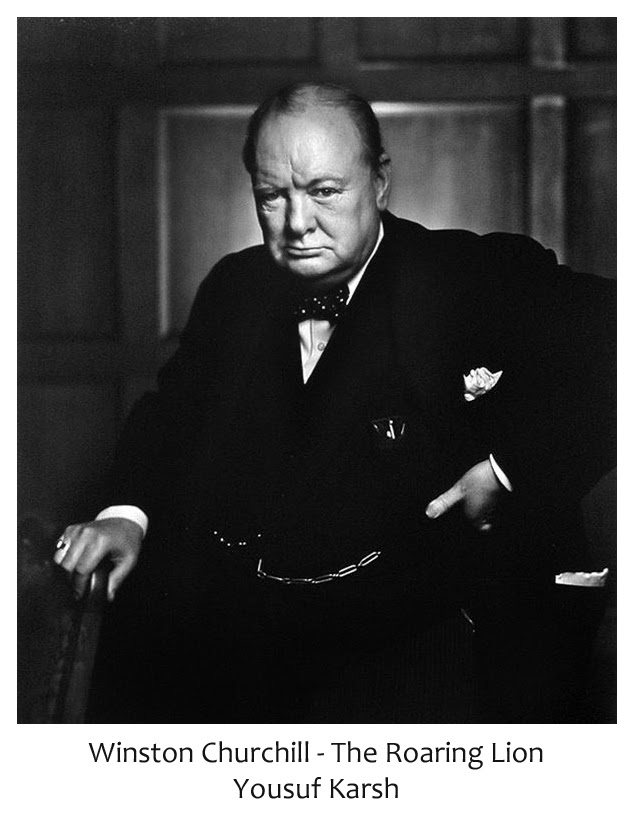
Yousuf Karsh, who shot to fame following his portrait of Winston Churchill; The Roaring Lion, has in his portfolio, images of many great heroes. Karsh’s images show great variety in posture and lighting while capturing brilliantly the individual character of the subject; as stated in the L.A. Times, ‘Each picture captures not only an image but a personality’. The body language, direction of gaze  and hand gestures work together with lighting and effects to hint at the type of person being portrayed. 
His portrait below of Albert Einstein is lit from slightly behind so that the light skims across his face, highlighting the deep wrinkles which show great wisdom and character; true to type, Karsh has captured the pensive look on the academic’s face. French author, François Mauriac’s silhouette is given an aristocratic feel using edge lighting to highlight only the edges of his noble features. Karsh’s portrait of playwright, Bernard Shaw is lit from a high angle creating strong highlights and shadows in his face and clothing; Karsh has perfectly captured Shaw’s quizzical demeanour.


Karsh’s became well known for his hero worshiping ethos and as a result, his subjects knew that going in front of his lens would bring them iconic status. He was trusted by all to bring out the best in his clients, boosting their public persona:
There is a brief moment," he believed, "when all there is in a man's mind and soul and spirit may be reflected through his eyes, his hands, his attitude. This is the moment to record. This is the elusive 'moment of truth.”
It has been written that Karsh’s motivation stemmed from a belief in the dignity, goodness and genius of human beings.
Karsh’s work has been in a variety of mass media, including postage stamps and currency and is recognised in both European and North American culture.  

Thursday, 14 August 2014

Introduction to Context and Narrative

Having completed my first Open College of Arts course, Art of Photography, I have decided to study towards the next two qualifications side by side. I feel that the two courses, People & Place and Context & Narrative could complement each other quite nicely.

While studying towards Art of Photography, I started to set up a small business photographing mainly portraits and events. I plan to join a camera club in October with the aim to join in their portrait sessions, increasing my skills with studio lighting as well as other aspects of photography.
I am a member of several photography based social network groups, one of which is sometimes used to arrange practical visits and weekends, mainly around Yorkshire.
The last project, Illustration and Narrative on my previous course opened a whole new world for me. I have always loved images which tell a story, from a series of pictures to a single image, showing a hint of something which has, or is just about to happen.
The research involved in this assignment lead me to photographers such as Don McCullin, famed for his powerfully emotive war and street photography. I have also been inspired by some of the street photography shown on the social networking groups which I visit.

I hope that throughout this course, I will develop the skills to create thought provoking images which appeal on both a visual and emotional level.